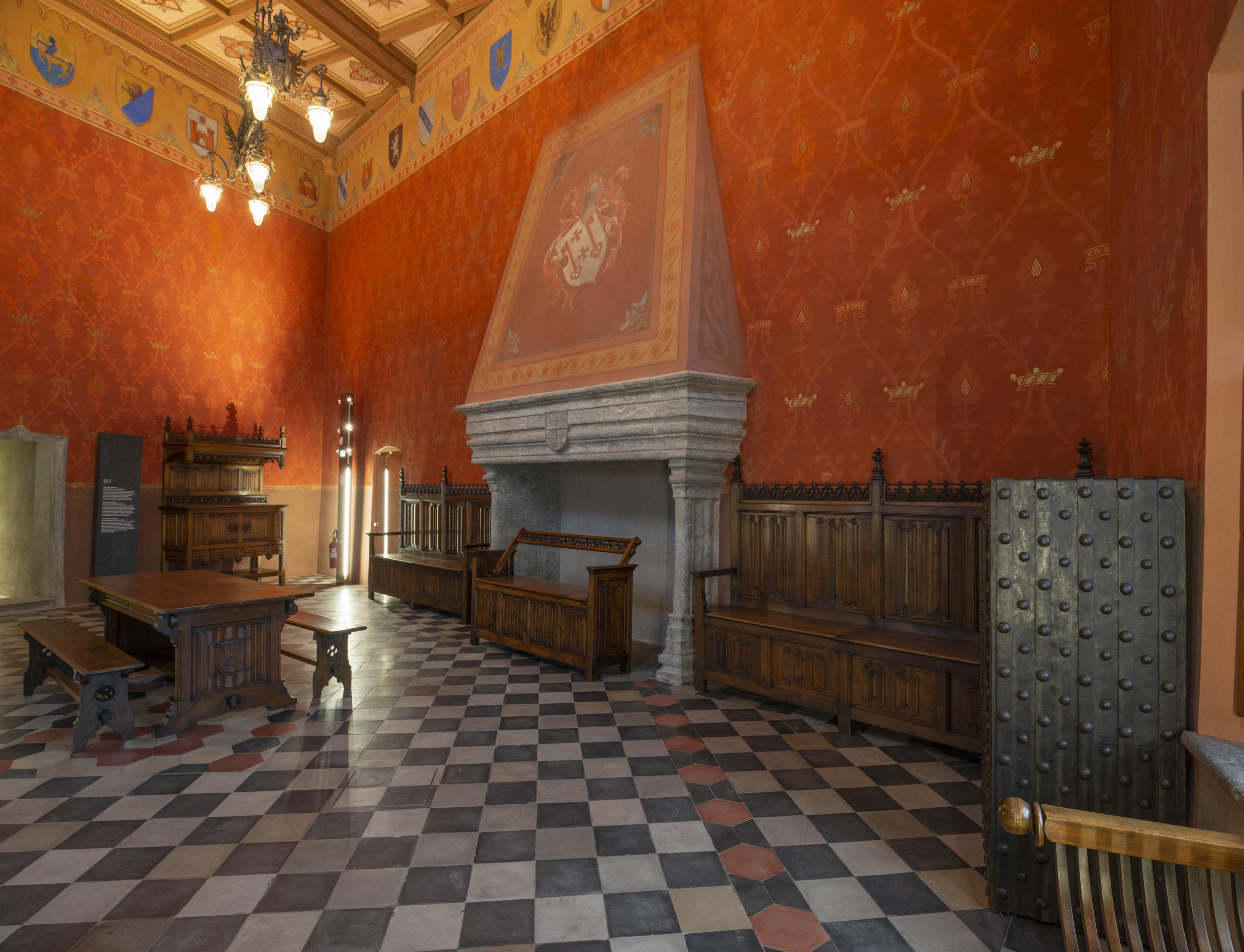

The Coats of Arms Room at the Saint-Pierre Museum
Archaeology, Art History, and the Fireplace That Endured It All
Estimated reading time
4
First room of the exhibition layout, first historical layer of the castle: 19th-century Neo-Gothic decorations and a 16th-century fireplace bearing the coats of arms of the Roncas and Saint-Pierre families.
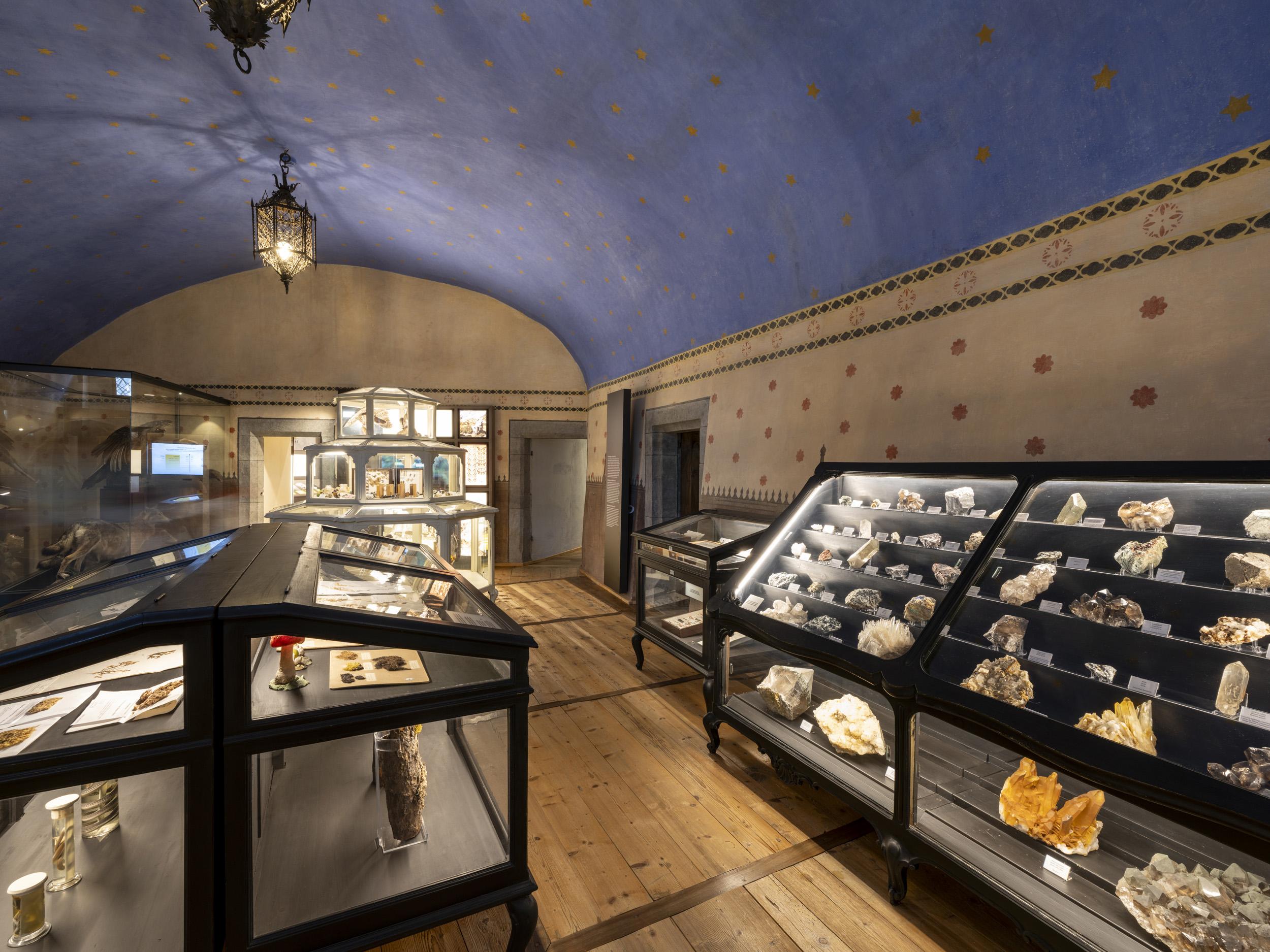
It is the very first room visitors pass through upon entering the Efisio Noussan Regional Museum of Natural Sciences. The walls are decorated in Neo-Gothic style, the vaults are intricate, and the details refined. Everything speaks of the Middle Ages, yet almost nothing visible is actually medieval. The Room of Coats of Arms (Sala degli Stemmi) is one of the most intriguing examples of how the Castle of Saint-Pierre is, even before being a natural science museum, an architectural palimpsest—a space where centuries of transformations physically overlap, each leaving its own signature.
The Nineteenth-Century Transformations
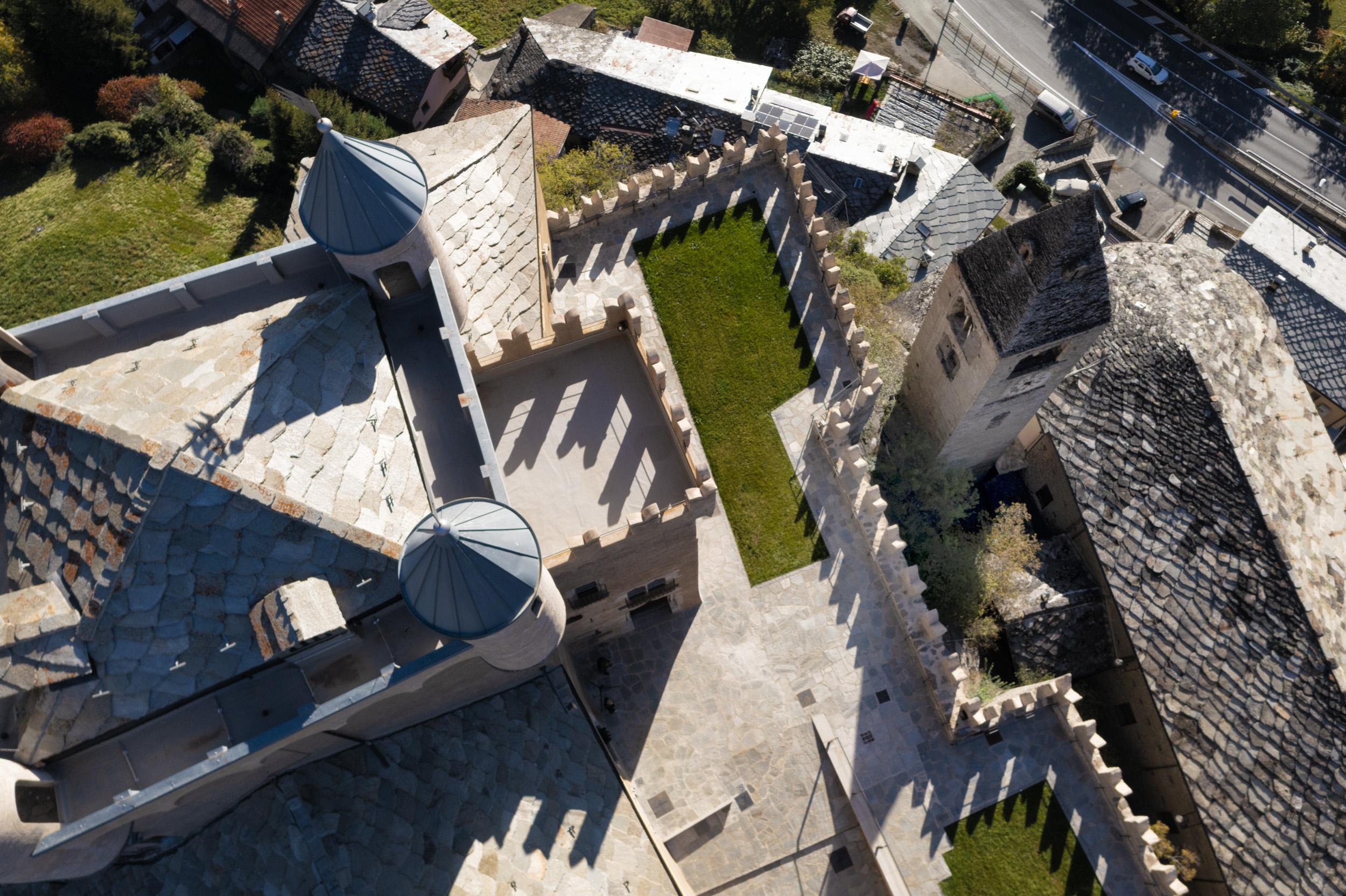
The room’s current appearance is the result of a radical intervention carried out at the end of the 19th century. It was commissioned by Federico Emanuele Bollati, a lawyer and superintendent of the State Archives in Turin, who had purchased the castle in 1873 with the intention of converting it into a stately residence matching the Romantic taste of the era. Bollati entrusted the project management to the engineer Camillo Boggio from Canavese, who had already designed the castle’s famous Neo-Gothic turrets, drawing inspiration from the manors of the Rhine Valley.
To decorate the Room of Coats of Arms, Boggio hired the Artari painters and the sculptor Giovanni Comoletti. The result is a space in an eclectic Neo-Gothic style, designed to evoke the medieval atmosphere of a feudal castle rather than document it with historical accuracy. Walls, vaults, and secondary furnishings were completely remade during this period, erasing all traces of earlier phases.
The Sole Survivor: The Great Fireplace
In this room completely reinvented during the 19th century, a single element withstood every transformation: the great fireplace, the only original fixture from the castle’s 16th- to 17th-century phase.
The fireplace is not merely a valuable architectural feature; it is a heraldic document. Carved onto its surface are the coats of arms of two families that left a deep mark on the history of the castle and its surrounding territory: the Roncas and the Saint-Pierre families. The Roncas owned the castle during the 17th century, after the Vuillet family completed its construction in the 16th century. The Saint-Pierre family were the lords of the medieval fiefdom from which the castle took its name, with its first documented mention dating back to 1191.
Two coats of arms, two genealogies, centuries of Aosta Valley history condensed into a single stone artifact. The fireplace survives as a silent witness to all the lives this space has seen, indifferent to the 19th-century redecorations surrounding it.
The Room in the Context of the Castle
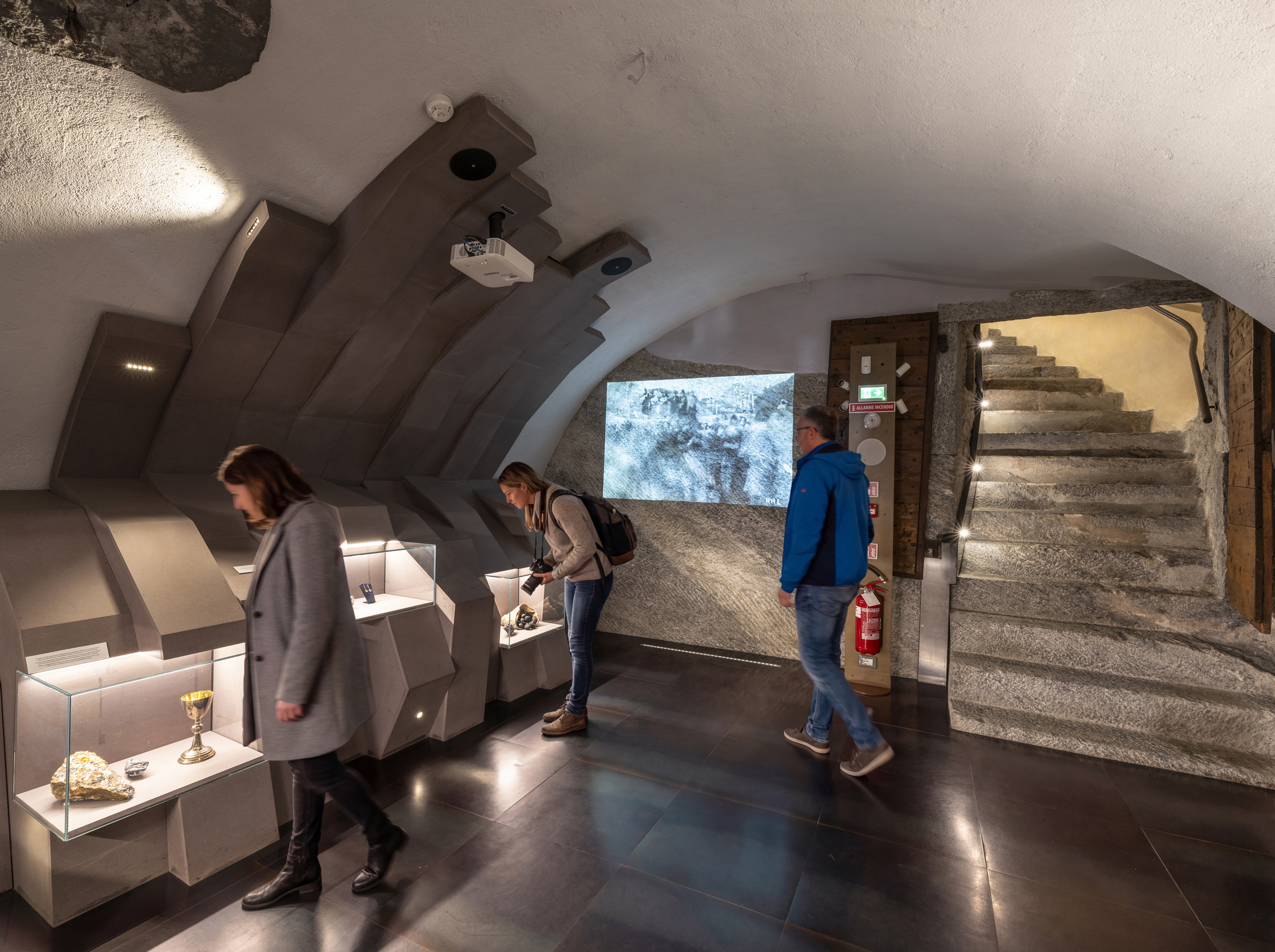
The Room of Coats of Arms is located on the castle’s lower floor, near the main entrance. Its function within the exhibition layout is twofold: it introduces visitors to the museum’s natural science collections while simultaneously introducing them to the building’s historical stratification.
This is a significant curatorial choice: the Museum of Saint-Pierre is not just a neutral container for natural science collections; it is itself a historical, architectural, and artistic document worth reading with the same close attention given to the specimens in the display cases.
Archaeological excavations conducted in the castle during restoration and museum conversion work yielded materials and structural evidence that allowed historians to reconstruct the building’s history from its medieval founding through its 19th-century transformations. The findings from these investigations are documented on historical panels distributed throughout the museum’s various rooms.
How to Recognize the Coats of Arms
For those looking to identify the coats of arms carved into the fireplace, the armorial bearings of both the Roncas and Saint-Pierre families are recognizable by their traditional heraldic elements, which are documented in historical sources from the Aosta Valley. The presence of both on the exact same artifact suggests that the fireplace was made or modified during a period when the two families were connected—likely during the 16th or early 17th century, when ownership of the castle passed from the Vuillets to the Roncas through marriage alliances and property transactions.
Photo: Archive RAVA