The Secret Life of the Alpine Forest
Ecosystem, Biodiversity, and the Mont Avic Natural Park in Val d'Ayas
Estimated reading time
8
The conifer forest is one of the richest and least-known ecosystems in the Aosta Valley. A world that reveals itself especially at night, among sounds, shadows, and silent presences.
There is a moment in the day when the alpine forest stops being a backdrop and becomes the protagonist. It is sunset, when the light filters obliquely through the trunks of larches and firs, the shadows stretch across the undergrowth, and the sounds of the day give way to those of the night. It is the moment when the forest reveals its true nature: an extraordinarily complex ecosystem, inhabited by species that live in the shadows, in silence, in tree cavities, beneath bark, and among roots.
The conifer forest is one of the most widespread ecosystems in the Aosta Valley and among the richest in life, even though most of this life is not visible during the day.
The Conifer Forests of the Aosta Valley
Conifer forests cover an altitudinal range from approximately 1,000 to 2,200 meters above sea level, occupying the slopes of nearly all the valleys of the Aosta Valley. The dominant species vary according to altitude, exposure, and soil conditions: the larch (the only European conifer that sheds its needles in winter) dominates sunny slopes and higher elevations, while Norway spruce and silver fir prefer wetter and shadier slopes. Scots pine characterizes the dry, rocky slopes of the lower and middle mountain zones, while the Swiss stone pine, one of the longest-lived and most fascinating species of the Alps, is concentrated at higher elevations, often growing alongside larch.
Each tree species creates a specific microhabitat around itself, with conditions of light, humidity, and soil composition that determine the presence of different plant and animal communities. The conifer forest of the Aosta Valley is not a uniform environment: it is a mosaic of continuously evolving microhabitats, shaped by the natural dynamics of trees, periodic disturbances such as avalanches, windthrow, and fires, and by the pressure exerted by wildlife.
The Forest’s Nightlife
It is at night that the alpine forest expresses its greatest ecological complexity. As darkness falls, species that remain hidden or inactive during the day become active: nocturnal mammals, birds of prey, amphibians, and nocturnal insects.
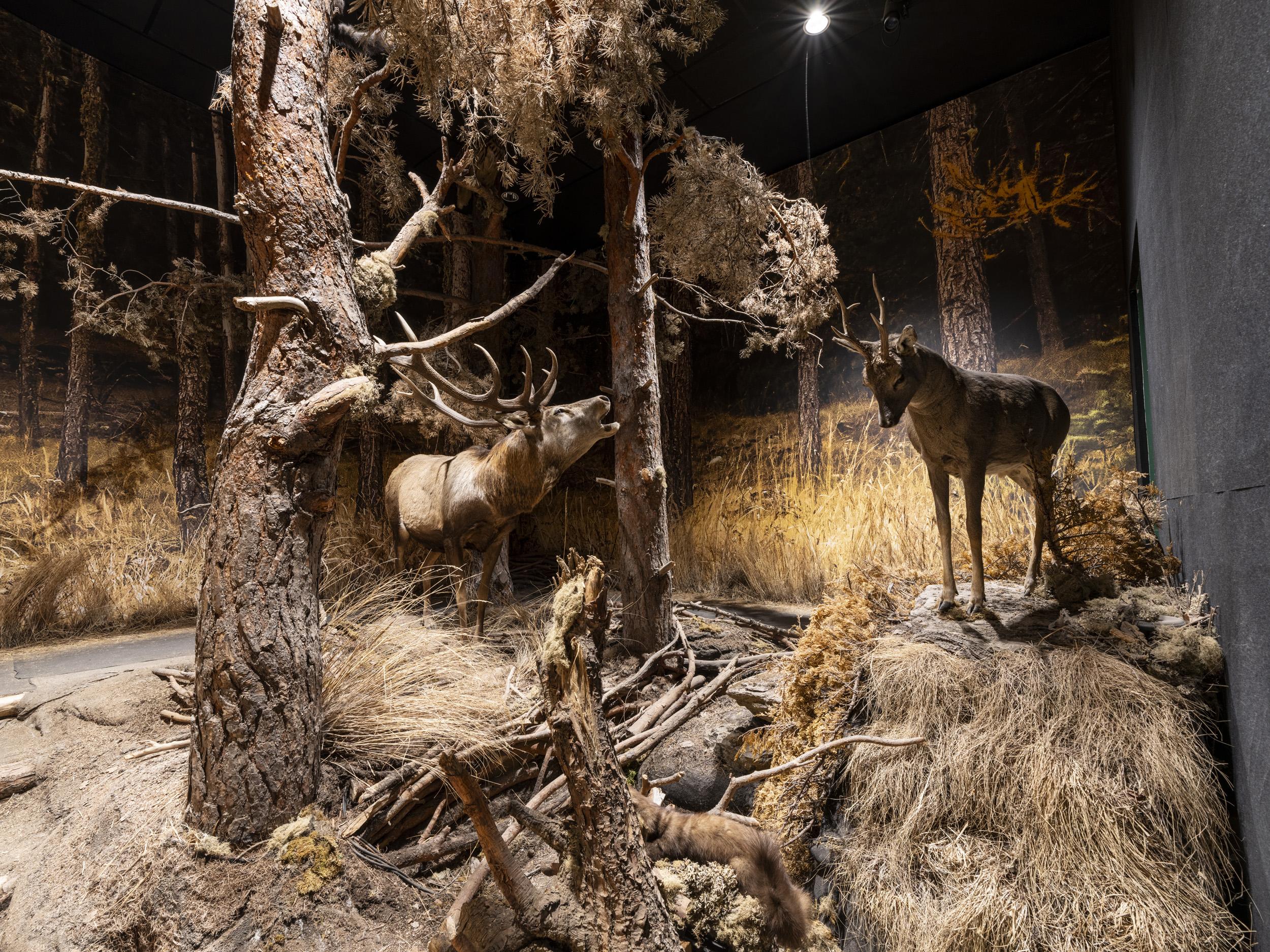
The badger emerges from its den at sunset to follow its usual routes in search of earthworms, fruits, and small vertebrates. The pine marten moves agilely among the branches, hunting birds and small mammals. The roe deer, active mainly during twilight hours, browses on shoots and herbs in the undergrowth, alert to the slightest sound. The black woodpecker, which spends the day excavating cavities in dead tree trunks, gives way at night to bats, which use those same cavities as shelters.
Nocturnal birds of prey are the undisputed stars of the alpine forest at night. The Eurasian eagle-owl, the largest owl species in Europe, specialized in hunting squirrels, emits its characteristic low, repeated call from the branches of larches. The tawny owl patrols the forest edges with its unmistakable call. The Eurasian eagle-owl, Europe’s largest nocturnal raptor, glides silently over clearings in search of hares and foxes.
Amphibians are among the species that benefit most directly from darkness: frogs, toads, and newts emerge from their damp refuges at sunset to hunt insects and spiders, filling pools and streams with their calls. The fire salamander, with its yellow-and-black coloration, slowly crosses the damp forest floor on summer nights, almost motionless in its slowness.
Sound as the Key to Understanding
More than sight, it is hearing that allows us to understand the nocturnal forest. The calls of birds of prey, the songs of amphibians, the chirping of insects, the rustling of leaves beneath the steps of a mammal: every sound provides precise information about the identity and activity of a species. Ethologists and naturalists who study forest wildlife increasingly use automatic recording devices—so-called bioacoustic recorders—to monitor the presence and activity of nocturnal species, obtaining data that direct visual observation could never provide.
Where to Go: Mont Avic Natural Park
For those who want to physically enter this ecosystem and observe its richness firsthand, Mont Avic Natural Park, in the municipality of Champdepraz, is one of the most extraordinary destinations in the Aosta Valley.
Established in 1989, Mont Avic Park is the regional natural park of the Aosta Valley with the wildest and least human-altered conifer forests in the entire region. Its 6,800 hectares of protected land include nearly untouched forests of larch, Norway spruce, and Swiss stone pine, glacial alpine lakes, wetlands, and high-altitude meadows. Its wildlife is rich and diverse: roe deer, chamois, ibex, foxes, martens, black woodpeckers, Eurasian pygmy owls, and numerous species of diurnal and nocturnal birds of prey.
The park’s trails are well marked and accessible to hikers of all levels. The Champdepraz Visitor Center provides detailed information about the area, the species found there, and recommended routes. For those wishing to experience the nocturnal forest, the park periodically organizes guided sunset and nighttime excursions led by expert naturalists who help visitors recognize the sounds and tracks of wild animals.
In July, the park is at the height of the alpine summer: the days are long, the trails are free of snow, and wildlife is active and visible. It is the ideal time to immerse yourself in an ecosystem that becomes more surprising the more you get to know it.
Photo: Stefano Venturini - Archive RAVA