The Entomological Collections of the Saint-Pierre Museum
8.800 Specimens and Decades of Research on Aosta Valley Biodiversity
Estimated reading time
3
Butterflies, beetles, and grasshoppers collected across the Aosta Valley over more than a century of naturalistic studies: the entomological display cases of the Efisio Noussan Museum are among the richest scientific treasures of the Western Alps.
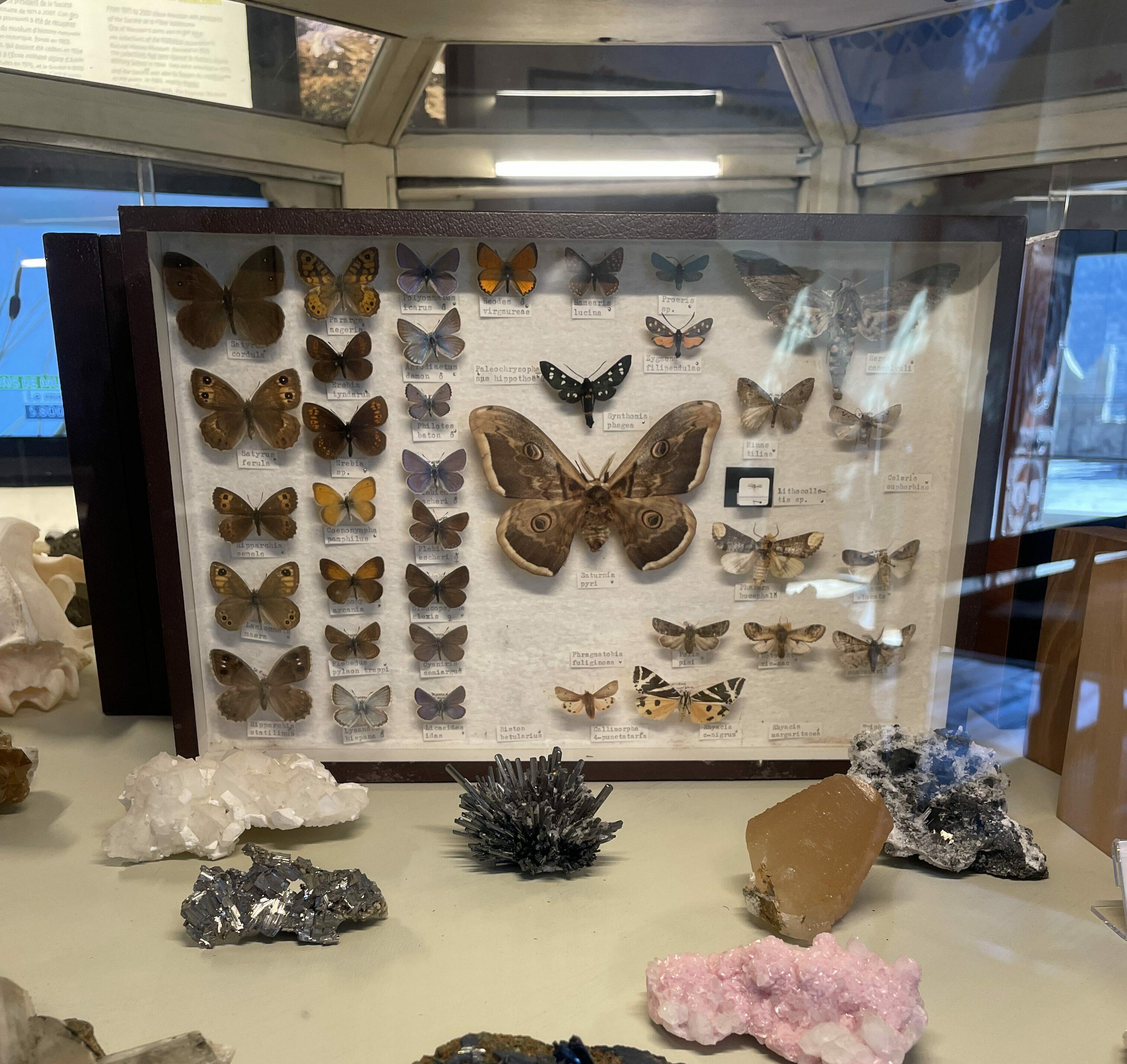
The entomological display cases of the Efisio Noussan Regional Museum of Natural Sciences are among the most photographed exhibits by visitors. Wings spread with millimeter precision, colors ranging from absolute black to brilliant orange, and geometries that seem impossible to find in nature—yet there they are, produced by evolution for precise purposes: camouflage, defense against predators, and attracting mates. But behind the visual spectacle lies something more structured and scientifically relevant than appears at first glance.
A Historical Archive of Aosta Valley Biodiversity
The Museum’s entomological collections currently comprise over 8,800 specimens distributed across 200 entomological boxes, which primarily feature three main groups of insects: butterflies (Lepidoptera), beetles (Coleoptera), and grasshoppers (Orthoptera). The collection is the result of decades of systematic studies conducted throughout the Aosta Valley, with sampling campaigns spanning the region’s valleys, meadows, forests, and wetlands.
Every preserved specimen is georeferenced (linked to the precise location where it was collected) and dated. This transforms the display cases into an archive of the historical distribution of species across the Aosta Valley, which can be compared with current observations to document how invertebrate fauna is changing under the pressure of climate change. Range shifts, the arrival of new species, and the disappearance of those most sensitive to environmental stress: the Museum’s entomological display cases record all of this with a level of precision that few other sources can guarantee.
Butterflies, Beetles, and Grasshoppers: Three Different Stories
Butterflies are among the most studied and recognizable insects in the Museum’s cases. Their wings, pinned on entomological supports, reveal color patterns and symmetries that evolution has crafted for specific functions: some patterns serve to confuse predators, others to signal toxicity, and still others to recognize conspecifics of the same species. Dozens of species found in the Aosta Valley are represented in the cases, from lowland butterflies to alpine endemics of high-altitude grasslands.
Beetles are the most species-rich group of insects on the planet, estimated to represent about 25% of all known animal species. Their rigid elytra offer a variety of shapes and colors that the Museum’s collection captures with particular effectiveness: from stag beetles with their developed mandibles to longhorn beetles with their extraordinary antennae, from alpine meadow beetles to soft-woodland scarabs of coniferous forests. The collection covers highly diverse environments, making it a significant cross-section of Aosta Valley beetle fauna across its various altitudinal zones.
Grasshoppers and Orthoptera more broadly (which also include crickets and locusts) are perhaps the group least known to the general public, yet their scientific utility is remarkable. As sensitive indicators of environmental conditions, their presence and distribution reflect the health of pastures and grasslands. The Museum’s display cases preserve numerous species, some of which are tied to very specific habitats such as the arid zones of the lower Aosta Valley or high-altitude grasslands.
Liquid Preservation
In addition to dry display cases, some invertebrates are kept in fluid preservatives—a technique that keeps soft tissues and internal anatomical structures intact. This proves essential for morphological and genetic studies that dry preparations would not allow. The two methodologies complement each other, expanding the range of scientific questions the collection can answer.
Display Cases in the Exhibition Route
Within the Museum’s exhibition layout, the entomological display cases represent a moment where Aosta Valley biodiversity becomes immediately readable: hundreds of different species, organized and comparable at a glance, in a space that makes visible what would otherwise require years of field observation in nature.
Stopping in front of an entomological case at the Museum means viewing the Aosta Valley from an unusual scale—that of an insect—and discovering that, even at that scale, the landscape is extraordinarily varied and complex.
Photo: Archive RAVA