The rocks tell a story
Alpine geology and the Matterhorn, as presented in Gallery 4 of the Saint-Pierre Museum
Estimated reading time
6
From the granite of Mont Blanc to the gneiss of Gran Paradiso, from the contours of the Matterhorn to the Dolomite-like shapes of the Cime Bianche: Room 4 of the Efisio Noussan Regional Museum of Natural Sciences takes visitors on a journey through the geological history of the Aosta Valley Alps
The beauty of the Aosta Valley mountains is no accident. It depends on the material they are made of: every peak has its own rock, its own history, its own geological time. This is the starting point for Room 4 of the Efisio Noussan Regional Museum of Natural Sciences in Saint-Pierre, dedicated to the geology of the Alps and the rocks that have shaped the landscape of the Aosta Valley over hundreds of millions of years.
A journey through the Alps
The Aosta Valley offers one of the richest and most accessible geological routes in the entire Alpine arc. Within a radius of just a few kilometres, it is possible to observe rocks of radically different origins, ages and compositions, each bearing witness to a specific chapter in the geological history of the Alps.
The granite of Mont Blanc formed around 300 million years ago through the slow solidification of intrusive magma deep within the Earth’s crust. It is a light-coloured, coarse-grained rock, characterised by the presence of quartz, feldspar and mica, which has emerged at the surface after millennia of erosion have removed the overlying rocks.
The gneiss of Gran Paradiso, on the other hand, belongs to the category of metamorphic rocks: it formed at great depth, under conditions of extremely high pressure and temperature, during the collision between the European and African continental plates that gave rise to the Alps. Its structure of parallel bands, visible on the massif’s walls, is a direct sign of those deformational processes.
The Matterhorn: African rocks in the Alps
The most fascinating geological phenomenon in the Aosta Valley is the Matterhorn. The pyramid that dominates the landscape of Breuil-Cervinia is an example of a klippe: a rock mass of African origin which, during the formation of the Alps, was transported hundreds of kilometres northwards and deposited on top of the underlying European rocks. The rocks forming the upper part of the Matterhorn therefore belong to a geological context completely different from that of the surrounding Alps: they are a fragment of the African continent that became lodged in the Alpine range.
Finally, the Cime Bianche, in the Monte Rosa area, display the characteristic rounded shapes of dolomitic rocks—calcium and magnesium carbonates formed in ancient tropical marine environments—which were subsequently uplifted and deformed by Alpine orogenesis.
Where to go: Breuil-Cervinia
For those who want to put what they’ve learnt at the museum into practice, the most extraordinary place to observe the geology of the Aosta Valley with the naked eye is Breuil-Cervinia, in the municipality of Valtournenche, at the foot of the south face of the Matterhorn.
By the end of May, the snow is retreating from the lower pastures and the pyramid of the Matterhorn, standing at 4,478 metres, stands out against the sky with a clarity that takes your breath away. You don’t need to be a geologist to see that this mountain is unlike any other. Just look up. And remember what you saw in Gallery 4.
Room 4 at the Saint-Pierre Museum
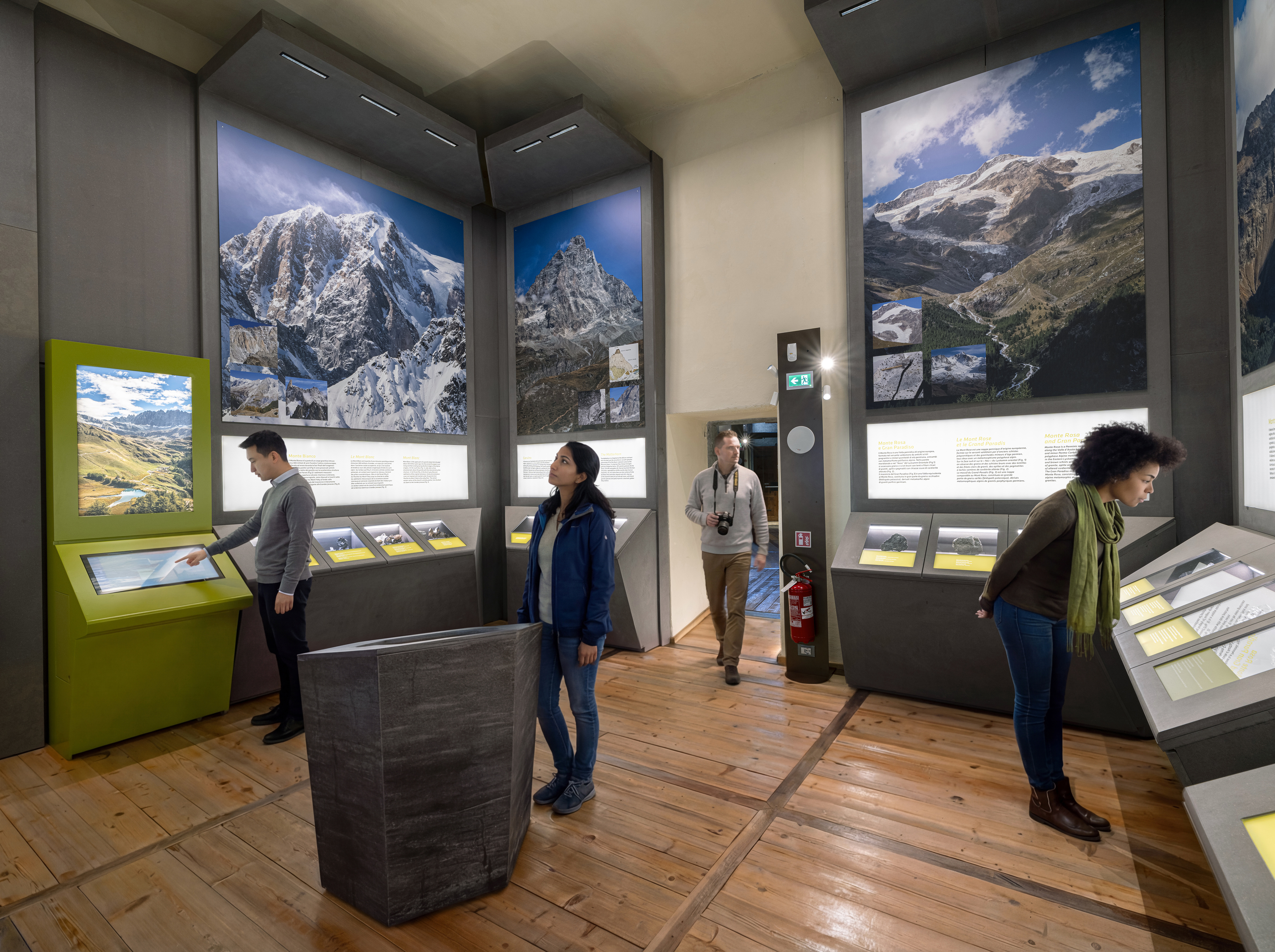
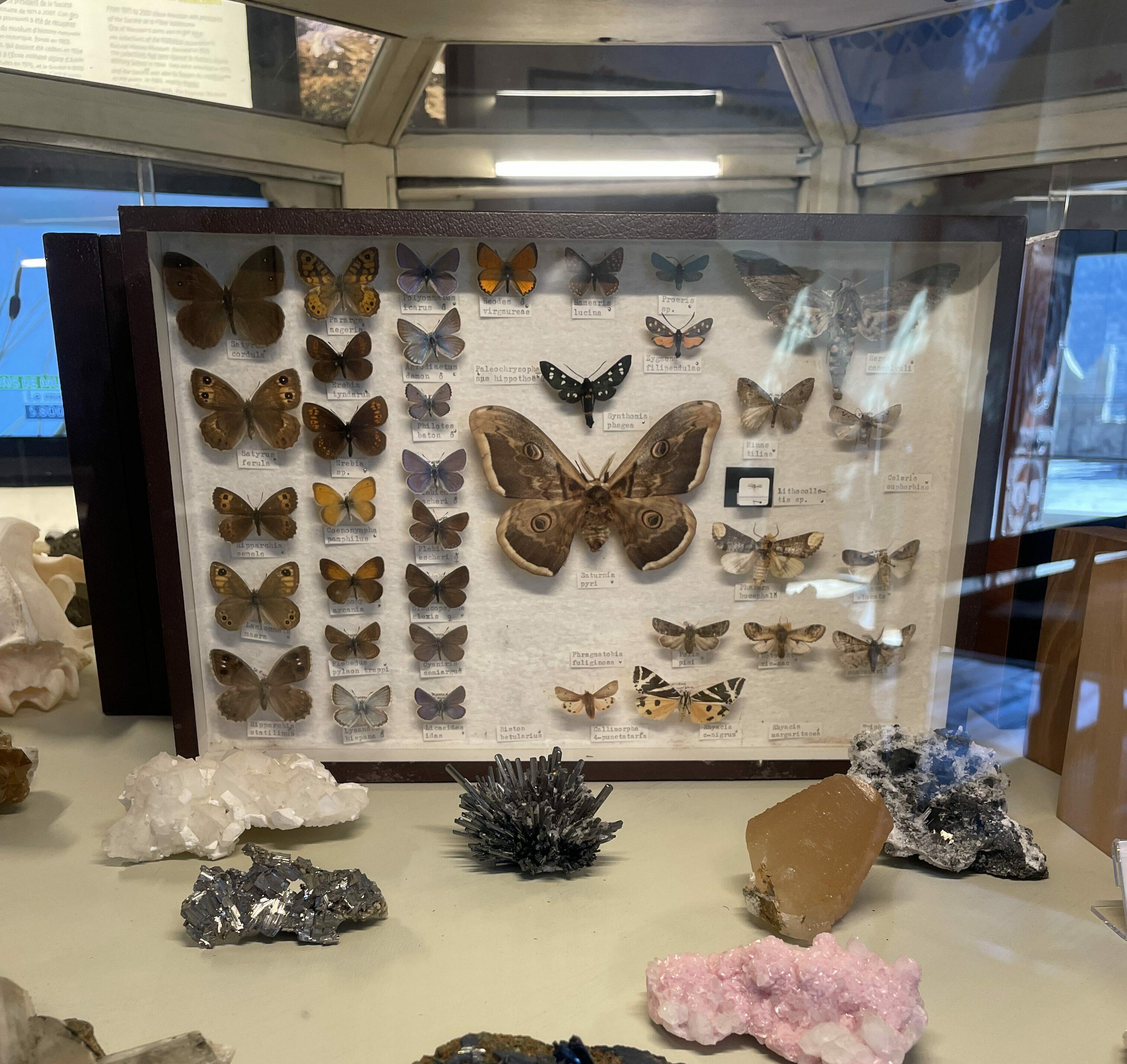
Room 4 of the Efisio Noussan Regional Museum of Natural Sciences explores the geology of the Aosta Valley through rock samples, large-scale photographs of the region’s main peaks, geological and soil maps, and virtual interviews with a geologist. The exhibition explores the characteristics of the region’s main geological units and the relationship between the geological structure of the area and the landscape that visitors can observe directly in the field.
Photo: Regional Museum of Natural Sciences