The Liquid Preparations of the Museum
How Amphibians and Reptiles Are Preserved in Natural History Collections
Estimated reading time
5
Ethanol, formalin, and glass jars: the liquid preservation technique—an alternative to taxidermy for amphibians and reptiles—and its scientific value in the collections of the Efisio Noussan Museum.
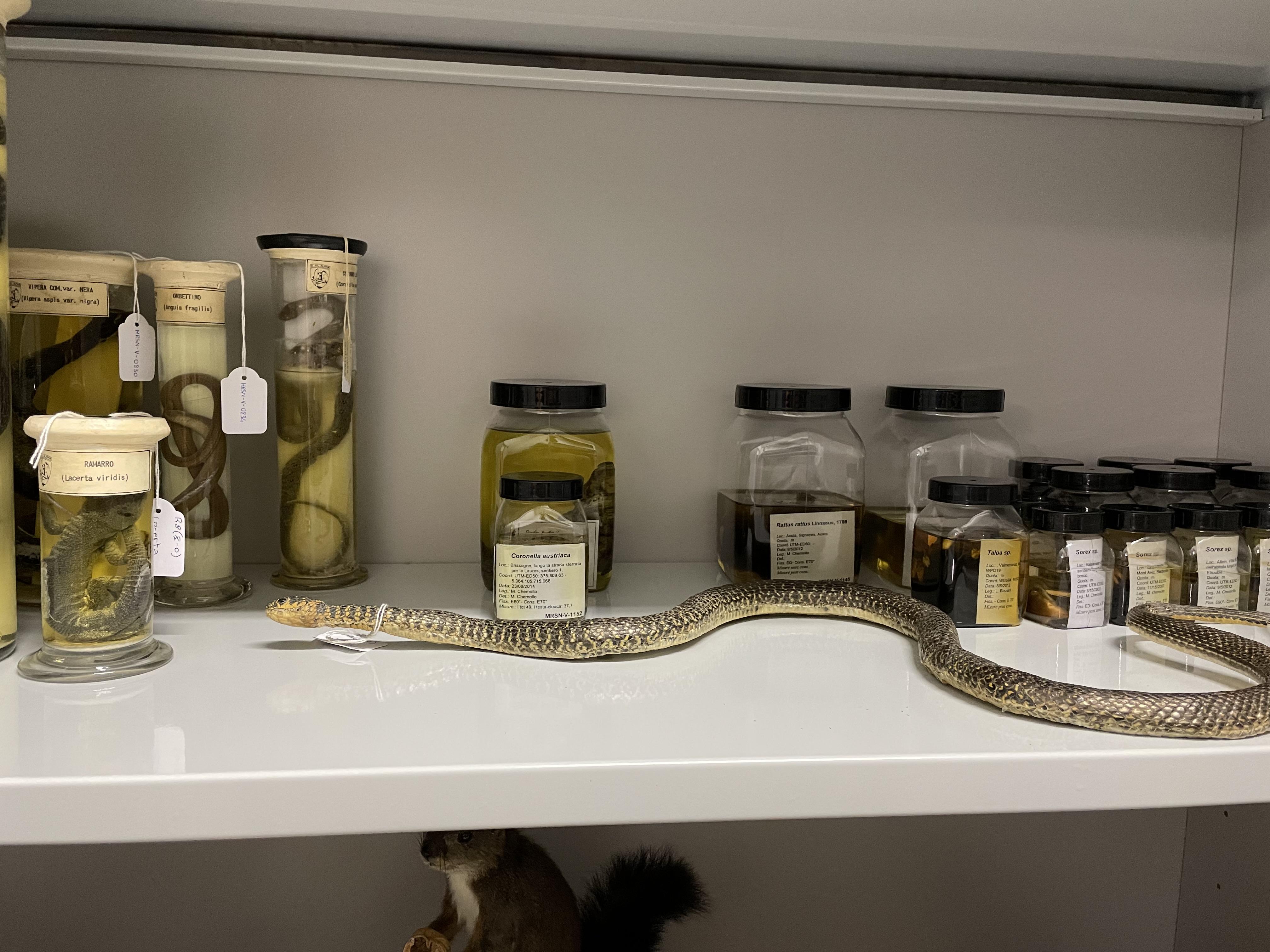
In the collections of the Efisio Noussan Regional Museum of Natural Sciences in Saint-Pierre, not all animals are taxidermied. Some are preserved in glass containers, immersed in liquid. This is a technique that has existed for centuries (Darwin’s jars collected during the voyage of the Beagle are still the subject of scientific study today) and remains irreplaceable for certain categories of animals.
Why taxidermy is not suitable for amphibians and reptiles
Taxidermy is based on removing the animal’s skin and mounting it over a form. For mammals, with their fur, and birds, with their feathers, the result is convincing and durable. For amphibians and most reptiles, it is not: the skin is often thin and delicate, tends to detach during processing, and deforms during dehydration. The scales of smaller reptiles can fall off during preparation. Furthermore, the surface structures that visually characterize the species (colors, textures, proportions…) alter in ways that are difficult to control.
Liquid preservation solves these problems by keeping the animal’s tissues intact in their original shape, without any removal or reconstruction work.
The two phases: fixation and definitive preservation
The process of preparing a liquid specimen generally consists of two distinct phases, using different substances and serving different functions.
The first is fixation: its purpose is to halt the enzymatic and bacterial processes of decomposition and to stabilize the tissues. In historical protocols (and today only in specific cases related to pure anatomical study), a solution of formalin (formaldehyde dissolved in water) is used, which penetrates the tissues and prevents their degradation. However, the use of formalin has been drastically reduced both because it is a toxic and carcinogenic substance, hazardous to the health of laboratory workers, and because it damages DNA. For this reason, today specimens are preferably fixed directly in high-grade ethanol (95%)—or a tissue sample is taken prior to treatment—thus ensuring safety and the integrity of the genetic heritage. For larger specimens, small incisions are made to facilitate fluid diffusion.
The second phase is definitive preservation: the specimen is transferred to a 70–75% ethanol solution, which guarantees its long-term maintenance without excessive dehydration.
The scientific value of liquid preparations
Liquid preservation offers scientific advantages that dry preparations cannot guarantee. The animal’s soft tissues (muscles, internal organs, delicate anatomical structures) remain intact and available for morphological and anatomical studies. Furthermore, thanks to the use of ethanol, DNA remains intact and can be extracted for genetic and phylogenetic analyses: a fundamental resource in the era of DNA barcoding and molecular taxonomy.
Liquid preparations are also protected from attacks by parasitic insects that damage dry collections: no insect can harm a specimen preserved in ethanol. However, they require constant maintenance: the level and concentration of the ethanol must be checked regularly to compensate for evaporation and to verify the seal of the containers. These are specimens that continue to require attention even decades after their preparation.
Photo: RAVA archive